Washington State traffic court is fun to watch. Drivers bring wildly inventive defenses and a surprising number win. This blog post provides some information to help orient DIY minded drivers to what they are up against if they contest a ticket.
Disclaimer
****This blog post is not legal advice ****
Each case varies and without a careful review of all the evidence in your matter there is no way to know your chances at a contested hearing. Even if you follow some of the strategies I discuss below, a judge could shoot you down because of your failure to correctly apply evidence rules, caselaw, local court rules, or statutory authority. Nothing in this post creates a client-attorney relationship.
As well, it should be noted that the list of strategies below is not exhaustive, and they may win or lose based on your jurisdiction and local court culture. I intentionally left out a few winning arguments I have heard over the years developed by other attorneys out of respect for their practice. Finally, I refrain from an extend conversation about the rules of evidence and how they may apply, favorably, to infraction defense. Hit the law library if you want to go down that rabbit hole.
Finally, the best place to learn about ticket defense is in the courtroom, not staring at a computer screen or asking chat GPT. Nothing beats waiting through a calendar or two to hear the arguments that work in your local court.
To contest, mitigate, or have found committed?
You can respond to your ticket in four ways: contest, mitigate, admit and have it found committed, or request a discretionary deferral which is up the judge and has strict elegibility requirements. This article discusses contested tickets. Look to the bottom of this post for more discussion about deferrals .
Insurance tickets - RCW 46.30.020(2) allows drivers with insurance tickets to bring proof of insurance to the clerk's office and the court will dismiss with a small fee if it was active at the time of the stop. At a mitigated hearing the court will sometimes drastically lower the fee if the driver shows they got insurance after-the-fact but can prove they have it for year or more.
Discovery Request
Fighting a ticket requires filing a discovery request with the prosecutor and court. IRLJ 3.1(b) says this has to be done at least 14 days before the hearing. Here's an example:
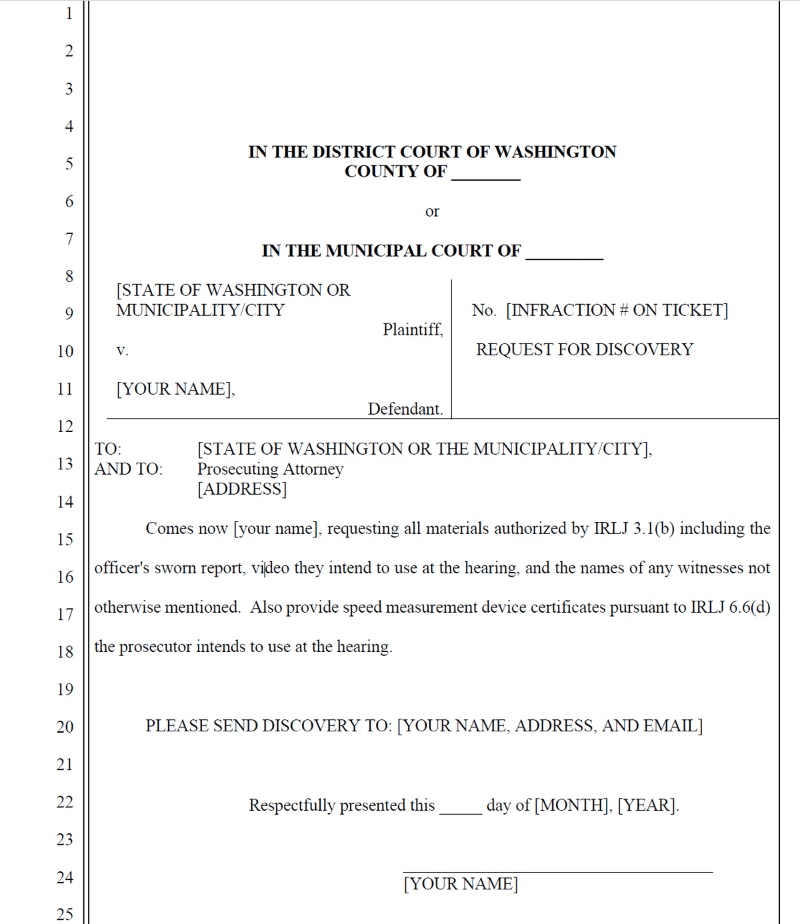
By local court rule, some courts keep the IRLJ 6.6(d) certificate on file and leave it up to the driver to get a copy through the court or by finding the device calibration records at the Washington State Patrol website.
Filing a certificate of service with the court establishes that you sent the discovery request to the prosecutor's office. Essentially this is a form sworn under RCW 5.50 that documents were mailed on a certain time and date. Although I cannot find a speeding ticket example online, here is an example of a certificate for another variety of case.
Losing Arguments
"I was in a pack and everyone else was driving over the speed limit"
"I feel like the police are picking on me"
"I have a right to travel according the uniform commercial code that my cousin showed me on the internet"
"I swear I wasn't speeding"
"The speed measurement device must have been broken".
I hear these arguments from DIY'ers just about every time I go to traffic court. They never work.
Arguing to Win
Winning arguments specifically address the facts of the case, caselaw, state statute, and court rules.
Infraction Rules
A passing familiarity with the infraction rules for courts of lesser jurisdiciton (IRLJs) go a long way. Look them up and apply them to the facts of your case.
Timeliness
Was the case filed with the court within five days of the officer issuing the citation? If not, IRLJ 2.2(d) requires dismissal. Was the hearing set outside 120 days from the date the ticket was issued? IRLJ 2.6(a)(1) says this is a problem, too.
Discovery Violations
Another common motion for dismissal is based on the requirements of IRLJ 3.1(b). That rule says, more or less, that the prosecutor has to provide discovery to the driver if requested at least 14 days prior to the hearing. This includes the officer's sworn report and any photographs or video the state intends to use. If they fail to do so, the rule says the court needs to suppress any information not provided. You will hear attorneys who never got a response from the prosecutor breezily move to dismiss according to this rule. Winning on this basis requires a timely discovery request and a certificate of service proving it was sent.
Speeding Ticket RADAR Device Tracking History
At infraction hearings, the jurisdiction issuing the ticket has to prove its case by a preponderance of the evidence. If they fail to do so, IRLJ 3.3(d) authorizes motions to dismiss.
Speed measurement device results are only as good as the skill of the citing officer. The National Highway Traffic Safety Agency's (NHTSA) radar manual explains the procedure for capturing a valid result. The agency authors a laser LIDAR manual as well.
The radar device can be in three modes: moving following, moving opposite, or stationary. If a required element of the tracking history is missing, it could lead to a winning argument in court. Lets assume the report says the device was in moving opposite mode. The page describing the tracking requirements is this:

Lets assume the report fails to show the officer verified the patrol speed. The page in the manual that describes the importance of speed verification is described here:

As you can see, verifying the patrol speed rules out the misalignment effect and is an "integral part of tracking history for moving R.A.D.A.R." Without speed verification, a driver could argue the jurisdiciton cannot prove its case by the preponderance of the evidence.
*Any materials used in argument, like the above excerpts from the NHTSA radar manual, need to be filed ahead of the hearing so the judge knows what you are talking about when you make your argument.
Speeding and the WSP 90 Day Speedometer Calibration
Another important document is the Washington State Patrol regulations manual. WSP will provide it upon request. Regulation 17.09.010 establishes that WSP troopers certify the calibration of their speedometers every 90 days by checking them against a radar device. Some Troopers fail to provide this cerification in their narrative and a driver could use this to their advantage.
Speeding, the IRLJ 6.6 Certicate, and the Speed Measurement Device Expert
Essentially, IRLJ 6.6 says that if a driver fails to demand the testimony of the speed measurement device (SMD) expert, the speed reading is admissible so long as the government provides a certificate that the device works properly.
Some courts keep the IRLJ 6.6 certificate on file according to local court rule, so the prosecutor does not even have to provide it in those jurisdictions. In others, the prosecutor provides the certificate in discovery. Here is the link to the WSP certificate website.
Issues involve whether the officer even wrote the device identification number into the report, up to date calibration, and whether the serial numbers of the tuning forks are the same as those in the report.
Some drivers take IRLJ 6.6 up on its offer and serve the prosecutor a request for the SMD calibration expert. This has to happen 30 days prior to the hearing. If the expert fails to show, the driver moves for suppression of the radar reading and dismissal under IRLJ 6.6(b).
Many traffic ticket attorneys appear to do this as part of their standard appearance packet and win becuase there are simply too many infraction hearings for the couple of state experts to attend every one. Experts try to appear as often as they can, so this is a dicey strategy.
Hearsay
IRLJ 3.3(c) says the rules of evidence apply at contested hearings. Evidence rule 802 prohibits hearsay. Hearsay is defined in ER 801 as: "a statement, other than one made by the declarant while testifying at the trial or hearing, offered in evidence to prove the truth of the matter asserted". For purposes of a traffic ticket, hearsay boils down to statements made by a third party that end up in the officer's report. Essentially, if the officer's sworn report is based on observations of another person, or another officer who did not write the report, those portions of the report are inadmissible and should be suppressed.
This circumstance usually happens at traffic collisions where the officer arrives after the fact and the report is based on a witnesses statement. Other instances involve officers working in tandem to catch speeders where one officer operates the SMD and the other officer pulls the driver over and writes the ticket.
However, any statements the driver made at the scene to the officer is not hearsay, so they ARE admissible according to ER 801(d)(2). This means if the driver admitted guilt and described the circumstance to the officer at the scene, and she wrote it into the sworn report, the judge can rely on this as evidence and find the ticket committed.
Officer's Signature
IRLJ 3.3(c) allows the judge to use an office's sworn (under oath) report to decide the case. In leiu of a sworn report RCW 5.50 allows for unsworn (declared under penalty of perjury) reports so long as they meet certain elements. Those elements can be found in RCW 5.50.010(3)(e), and RCW 5.50.050.
Other Options - Negotiate or deferral
If all else fails, prosecutors sometimes agree to a dismissal or reduction to non-moving violation if the driver shows proof of a driver's safety course. Many judges accept courses from idrivesafely.com.
Deferrals are a good option for some drivers without CDL licenses. The statute is RCW 46.63.070(5). WA drivers are eligible for deferrals every seven years. If granted by the judge , you pay the fee ($175 usually), and if you stay out of infraction trouble for a year the court will dismiss the ticket and it does not count against your insurance. HOWEVER I have heard from out-of-state drivers who had their WA ticket deferral request denied. My guess is that the judge figured there was no way to monitor whether the driver picked up out-of-state infractions and because the statute is discretionary the judge did not think it appropriate. There is no way to appeal the denial of a deferral petition, so that person was stuck with a committed ticket.
Good luck. If the above looks like too much gobbldygook to you, you can always reach out to a fair priced WA traffic ticket attorney.